

Pearlware

Many ceramic identifications are related to decoration, but when analysing historic ceramics we also look at the matrix of the vessel. White ceramics have evolved over time, and the changes in consistency, colour and glaze can do as much to help us identify a piece as decoration. Pearlware is one of the earlier types of whiteware […]
Lice Combs

Whether rich or poor, rural or urban, all people in the nineteenth century struggled with lice. Just over a hundred years ago, dealing with lice was a commonplace, unremarkable irritant. In fact, the lice comb is one of the most common personal artifacts that we dig up from Ontario historical sites. We find lice combs […]
Canary Ware

Canary ware is a refined whiteware with a glossy bright yellow glaze, which ranges from pale to deep yellow. The yellow in the glaze comes from antimony, which is toxic in certain forms. Potters who manufactured canary ware often developed blisters on their skin. Canary ware often has showy decorative motifs, including transfer printed mottos […]
Transfer Print: Olde Blue

Olde Blue is a style of transfer print where the image is almost a “negative,” the major elements are white or light and the background is dark blue. The shade of blue is very distinctive; it is a very dark cobalt, much darker than the blue used in later transfer prints. Unlike later transfer prints, […]
Queen’s Wharf Station Site
The 2011 Queen’s Wharf Station Site excavations documented the 1850s land making process that led to the original formation of the majority of the property, along with the remains of portions of the 1855-1856 Grand Trunk Railway engine house, the contemporary Garrison Creek channelization structure, and the Queen’s Wharf that extended into the project area.
Factory Slip: Mocha

In the nineteenth-century, these flowing designs were sometimes referred to as “seaweed.” The designs were supposed to resemble moss agate, which is also known as “mocha stone” (Priddy 2004:171). The artist used a brush to release drops of a “mocha tea” solution, with a combination of tobacco, stale urine and turpentine. The design spread instantly into a tree-like pattern […]
Hand-Painted: Early

Early hand-painted ceramics are usually pearlware, and the earliest used limited colour palettes, such as cobalt blue. After 1780, hand-painted wares began to incorporate earth tones such as orange (mustard), olive green and brown. The colours red and black did not appear until the 1830s. The hand-painted designs were most often floral motifs, ranging from […]
Yellow Ware

American yellow ware (or yellowware) has a dense, yellow-to-buff coloured body with a clear lead or alkaline glaze while the English variety has a cream to buff body with a yellow-tinted glaze. Annular factory slip decoration is most often seen, though sponged motifs and Rockingham glazes are not uncommon. Yellow ware should not be confused […]
Factory Slip: Encrustation
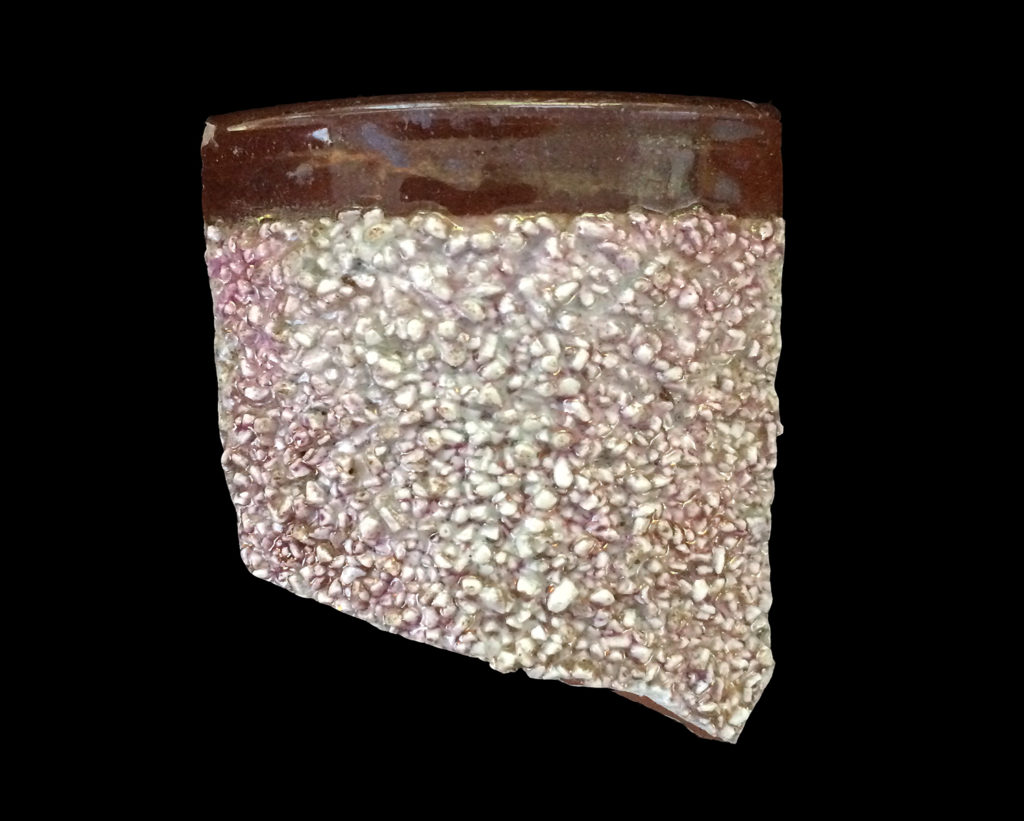
Some forms of ceramic vessels exhibiting different surfaces were produced using small dried pieces of clay in several colours. The clay bits were pressed into a solid colour slip field, producing the encrusted look. Sometimes a lathe, a machine that rotates an object on its axis, was used to smooth the vessel’s surface. This technique produced a finely-grained […]
Factory Slip: Cable

Cable ware, also known as “earthworm” by collectors, is a distinct factory slip motif. The decorative designs were produced using a multi-chambered slip cup, which would allow three or four different colour clay slips to flow onto the vessel. This category includes designs known as “cats-eyes” which occur from a single drop from a multi-chambered slip cup, with overlapped drops forming a […]