

In the academic world, and increasingly in mainstream media, we’ve been seeing the word “critical” attached to long-established ideas. These “critical” movements indicate a move to re-examine commonly held beliefs with new eyes, focusing on the specific power structures that they may represent and reinforce. In this vein, Critical Heritage looks at the field of Heritage or Heritage Studies and asks: who decided what is and isn’t “Capital H” Heritage and why? What were the power structures involved in making those decisions? And, perhaps more importantly, who and what has been excluded from Heritage as a result?
Critical Heritage is often discussed in opposition to the “Authorized Heritage Discourse”, or A.H.D., a term created by Dr. Laurajane Smith, Professor of Heritage and Museum Studies at Australian National University, to describe the established discourse around western Heritage that generally prescribes more value to aesthetically pleasing objects/sites from specific time periods and cultures (generally European, often Greco-Roman). The A.H.D. puts heavy emphasis on protecting these sites/objects for the education of future generations; using them to create a shared identity based on a prescribed, shared past. Critical Heritage Studies looks critically, for lack of a better term, at the role that the A.H.D. can play in nation-building and establishing and reinforcing colonial ideals of a “superior” ruling class (i.e. those who belong to the shared identity created by the A.H.D) and showcasing the differences between them and the “other”. The introduction to Harrison et al’s Critical Heritage Studies and the Futures of Europe describes this leveraging of heritage to certain other groups as “key to the colonial project, and to the justification of slavery and imperial expansion”.
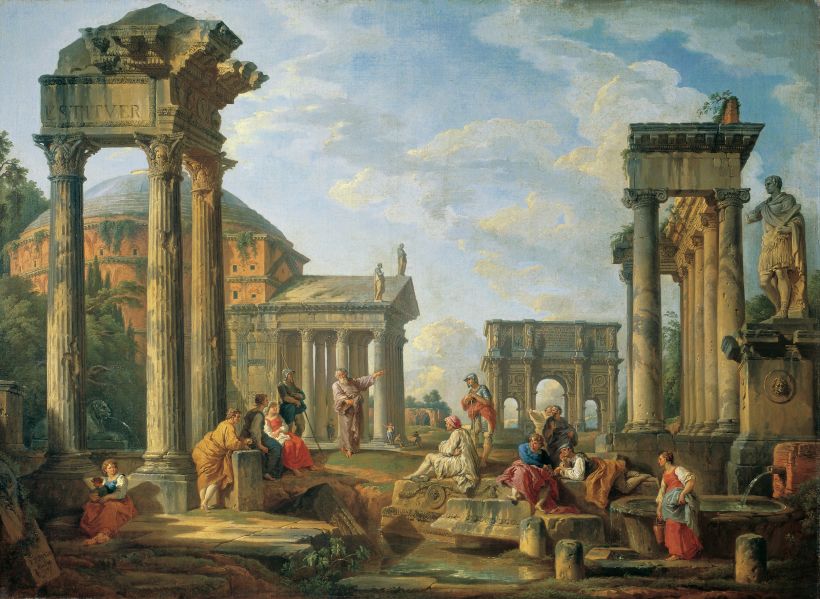
Case in point, the first image in a google search for “Cultural Heritage” is this Italian painting of Roman Ruins. This image is also the main image accompanying the Wikipedia entry for the same.
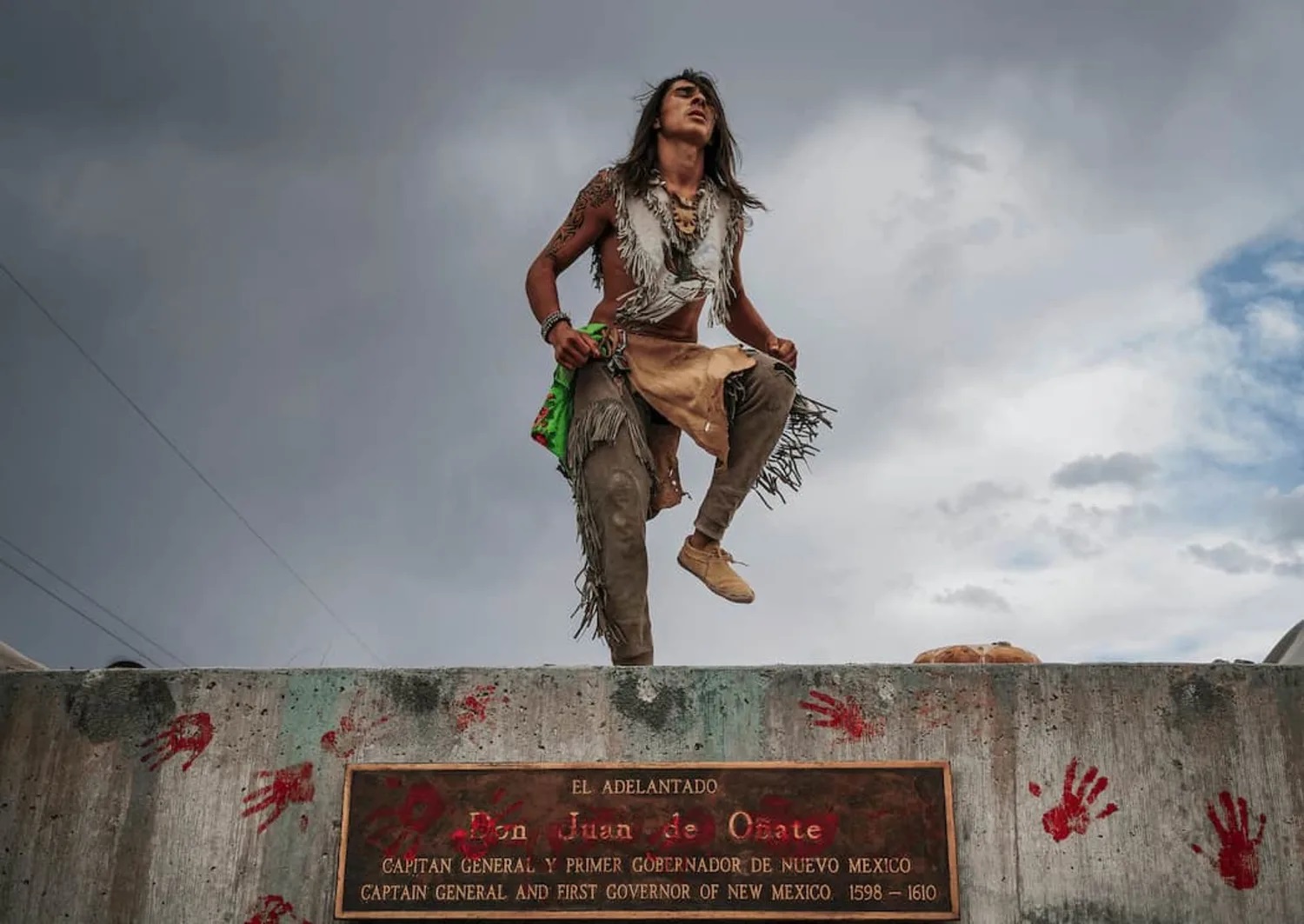
Randal H. McGuire further explores this relationship between Heritage and colonial power in the same publication. He examined statues of Spanish colonial “heroes” in New Mexico, a region where opinions on Spanish and American colonial powers are tied strongly to Hispanic, LatinX, American, and Indigenous cultural identities. He describes the relationship between Heritage and colonialism like this:
“Subjugating Indigenous peoples requires colonisers to seize control of the narrative, to conquer history itself. They established social structures, ideologies and institutions to impose authorized heritage discourses that demean or co-opt Indigenous peoples and legitimate the settler state” (page 290).”
According to Critical Heritage Studies and the Futures of Europe, Critical Heritage, at its core, seeks to expose and deconstruct “…the concrete ways in which power is caught up and exercised through the exhibition and management of museums and heritage sites…” (page 3). Perhaps an easier way to think about it is as a redistribution of the control of Heritage from the perceived elite ruling classes to the people. But this is maybe where Critical Heritage Studies hits its first major roadblock. If the end goal of Critical Heritage is to decouple Heritage from societal power structures and create an equal and inclusive space, then we need to ask ourselves (and our Critical Heritage scholars): how can this be accomplished so long as discussions of Critical Heritage remain confined to academia and practitioners of “capital H” Heritage: the keepers of the A.H.D.?
An inherent flaw with any academic pursuit that pertains to be “for the people” is that academia itself is, decidedly, not that. Even as a Heritage Professional myself, researching and writing this blog post, I found myself coming upon barrier after barrier to learning even the basics of Critical Heritage Studies. A simple Google search of the term “Critical Heritage” gives nearly 200,000 results, almost all of which are descriptions of university courses or academic articles hidden behind a paywall or only accessible if you are a member of a partner institution (read: university). If you’re lucky, you may be able to access some of these sites through your public library (but of course you first need to know which sites, how to do it, and that this is even something that you can do), at which point you’re met with articles so dense and rife with jargon that they’re nearly impossible to decipher for those not already in the know.

The unfortunate irony of movements like Critical Heritage is that they can so easily end up falling into the same academic echo chamber they aimed to climb out of. If the goal of Critical Heritage is indeed to move away from the A.H.D. then the movement needs to move beyond the institutions and spaces that helped create it. We need to be elevating other voices and shifting the focus of the work from the inside pages of Heritage journals and academic conference presentations out into the wider world.
I don’t mean to be all doom and gloom though, as in the last several years, Critical Heritage has started to make its way into the public discourse, though it often goes by its other name: “decolonization”. Decolonization efforts can range from using traditionally colonial spaces like historic house museums to tell more diverse and inclusive stories, involving communities in their own history-telling, repatriating artifacts, increasing transparency in collections policies, and forming lasting community partnerships, to taking ownership of past institutional mistakes.
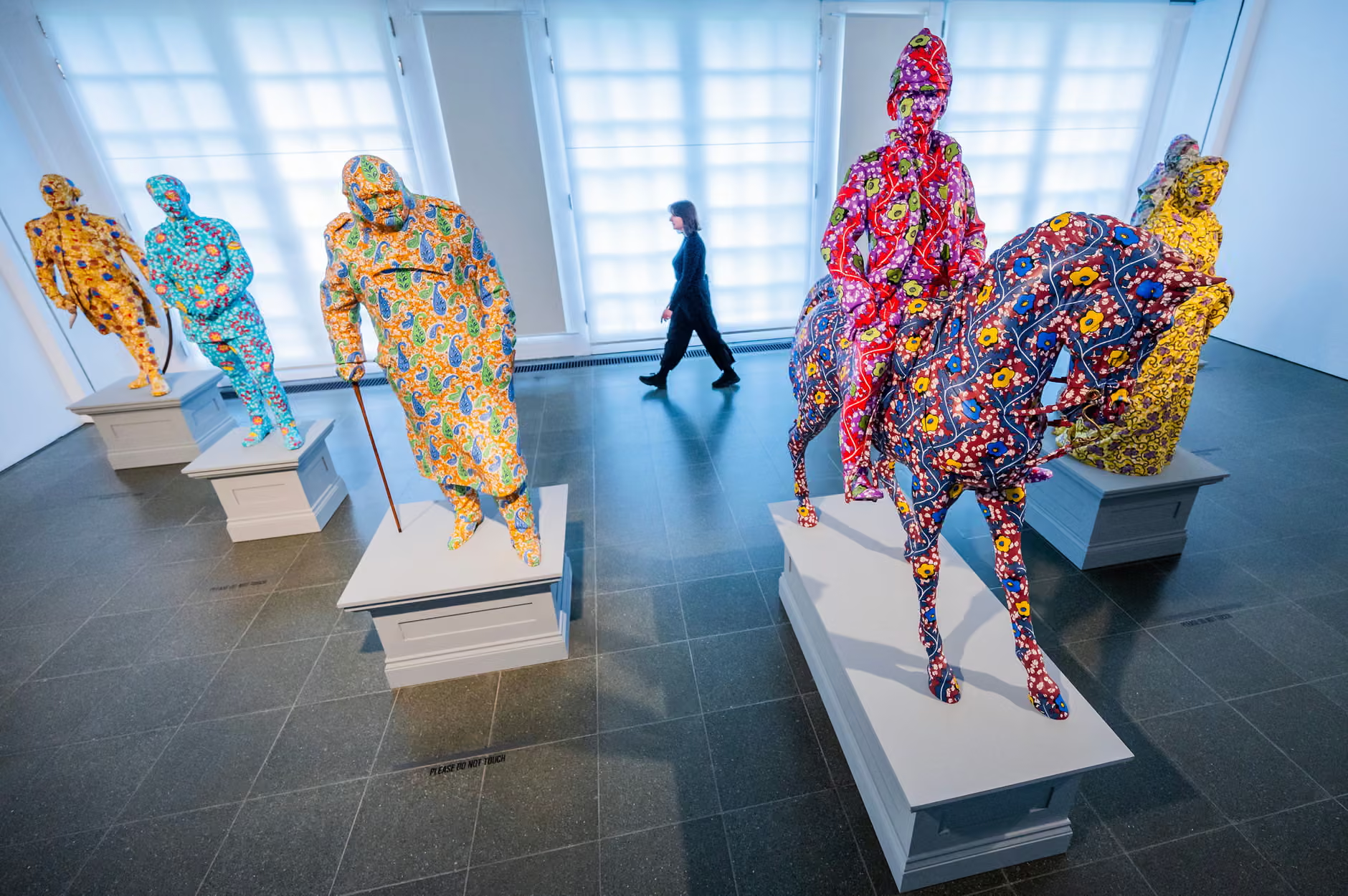
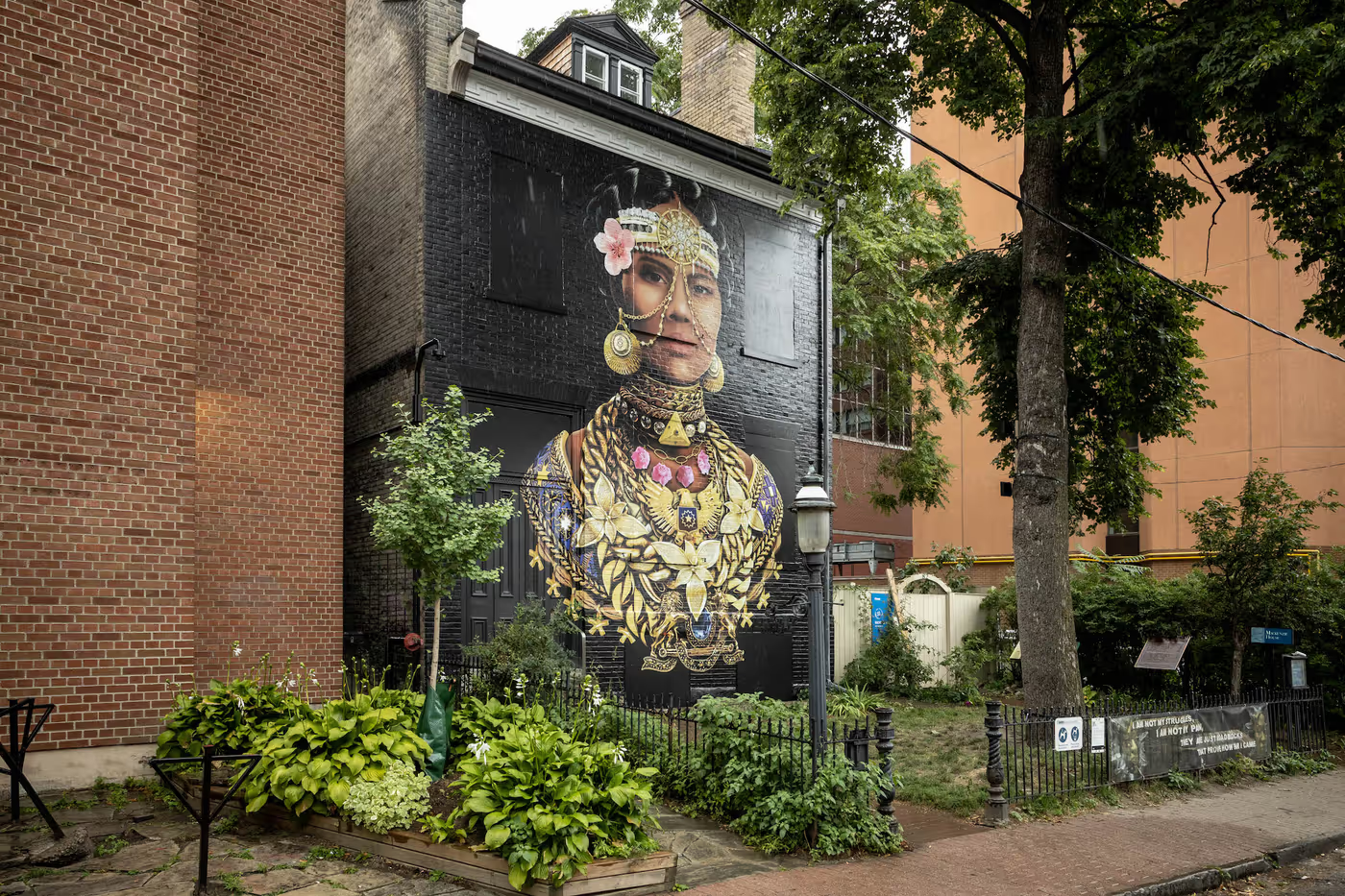
In the greater context of Heritage work here in Ontario, we are seeing more efforts to consult on projects with Indigenous groups and other stakeholders as well as grants and opportunities for communities to get involved and take ownership of their own heritage. These projects range in size from a large-scale, on-going review and update of the First Peoples Gallery at the ROM in consultation with indigenous leaders and knowledge holders, to making space for community-led exhibition spaces in local museums. Outside of museums, we are seeing changes to the public sphere as a result of Critical Heritage work, like the removal of the statue of Sir John A. Macdonald from City Park in Kingston or the renaming of Dundas Station in Toronto to TMU (Toronto Metropolitan University) Station (with TMU itself, having been renamed to sever ties to Adolphus Ryerson, a founder of the residential school system).
Critical Heritage at ASI
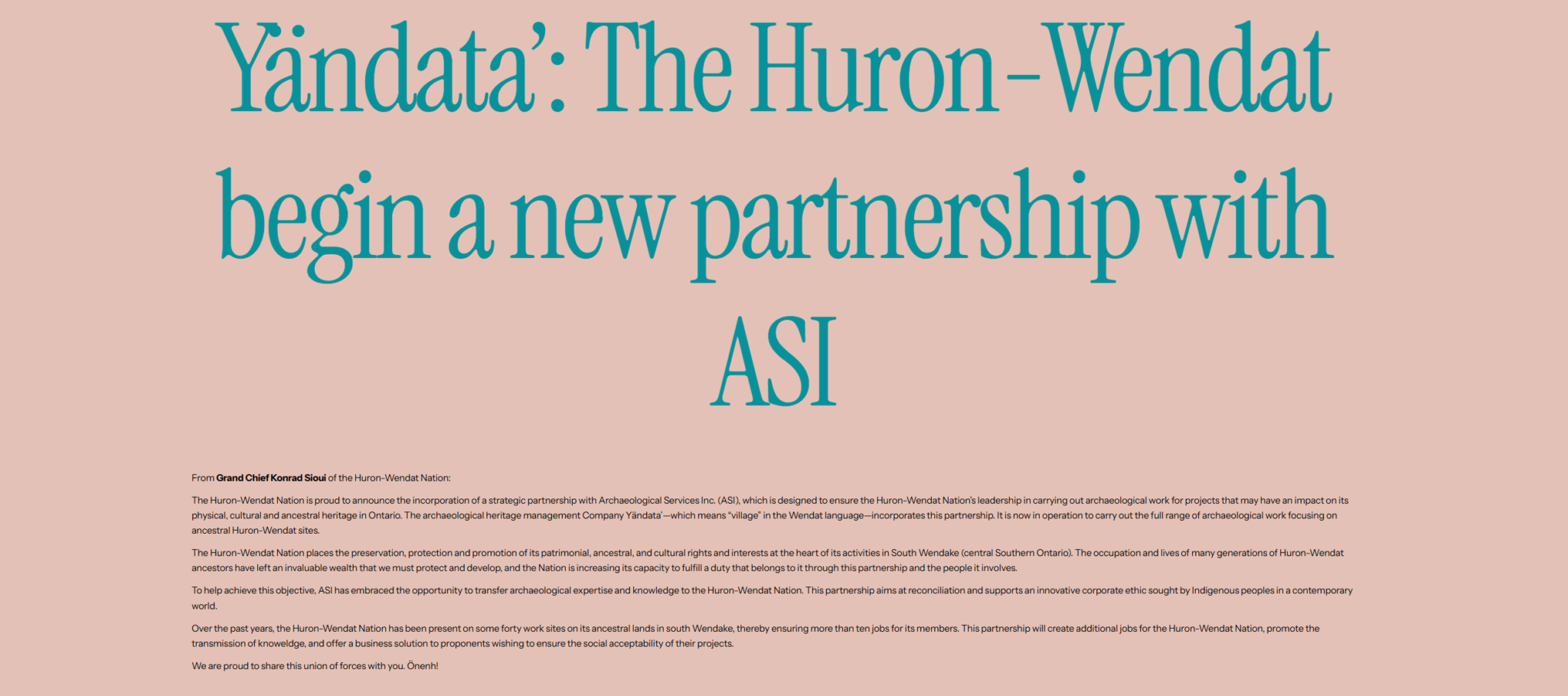
At ASI, we are working to incorporate Critical Heritage practices into all of our work, but an initiative that really showcases these efforts is the Yändata partnership with the Wendat Nation for a knowledge exchange of archaeological practices. This partnership aims to ensure the Nation’s leadership in carrying out archaeological work focusing on Wendat sites. You can learn more about the Yändata partnership here.
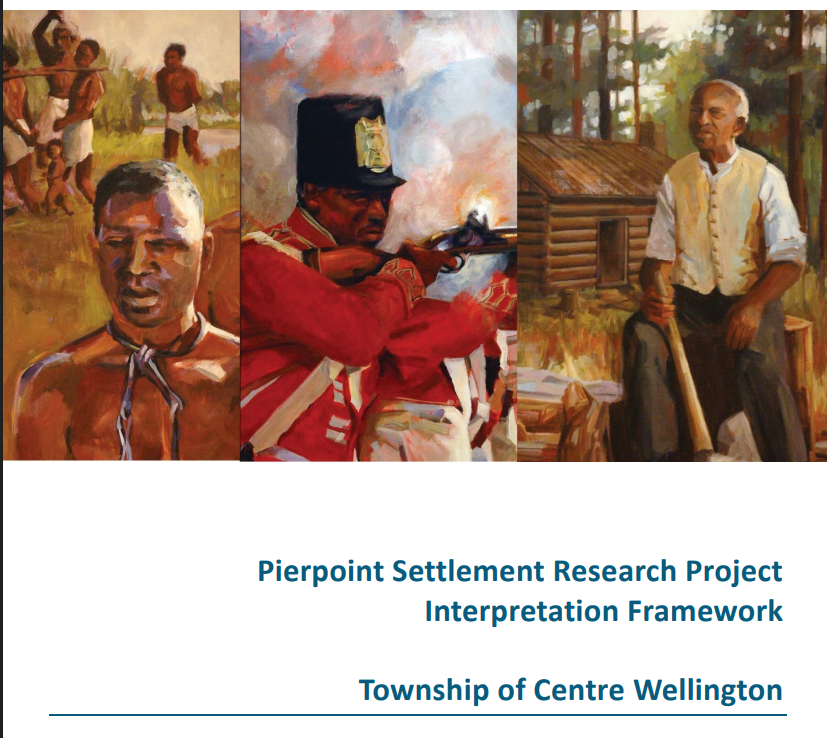
In Fergus, ASI also helped to develop an interpretation framework for the Pierpoint Settlement, the former property of Richard Pierpoint, a formerly enslaved man from Senegal who fought for the British in multiple wars before eventually settling in Wellington County. Pierpoint was a “griot” a gifted storyteller in the West African tradition, and his property became a known resting place for travelers heading northward. The project included extensive community outreach and aimed to speak to the story of not only Richard Pierpoint, but also the larger history of Black land ownership in Upper Canada. The full report can be found here.
So, while Critical Heritage Studies may still feel somewhat out of reach or intangible to those outside of the hallowed halls of academia, the truth is that the actual work of Critical Heritage is done by regular people. Critical Heritage is community and cultural advocacy groups, it’s outreach, it’s diversifying points of view, it’s looking at difficult histories, it’s asking questions and holding institutions to account. It is by doing these things that we can ground the Critical Heritage movement and turn it into something that’s not only “for the people” but “by the people.”
Written by Leora Bebko
References
Canada Chapter. “Association of Critical Heritage Studies.” Association of Critical Heritage Studies , 2019, www.criticalheritagestudies.org/canada-chapter. Accessed 11 May 2026.
“Association of Critical Heritage Studies | Centre for Heritage & Museum Studies.” Anu.edu.au, 2026, chms.cass.anu.edu.au/research/projects/association-critical-heritage-studies. Accessed 11 May 2026.
Ashley, Susan L.T., et al., “Introduction: Critical Heritage Studies in Canada”, Journal of Canadian Studies, vol. 52, no. 1, 2018, University of Toronto Press, https://utppublishing.com/doi/abs/10.3138/jcs.52.1.01.
Gentry, Kynan & Smith, Laurajane. (2019). Critical heritage studies and the legacies of the late-twentieth century heritage canon. International Journal of Heritage Studies. 25. 1-21. 10.1080/13527258.2019.1570964.
Harrison, Rodney, et al., editors. Critical Heritage Studies and the Futures of Europe. UCL Press, 2023. JSTOR, https://discovery.ucl.ac.uk/id/eprint/10178909/1/Critical-Heritage-Studies-and-the-Futures-of-Europe.pdf.
Harrison, Rodney. “CONCLUSION: On Heritage Ontologies: Rethinking the Material Worlds of Heritage.” Anthropological Quarterly, vol. 91, no. 4, 2018, pp. 1365–83. JSTOR, http://www.jstor.org.onlineresources.tpl.ca:2048/stable/26646269.
“What Is Heritage? | OpenLearn.” Open.edu, 2026, www.open.edu/openlearn/mod/oucontent/view.php?id=1929&printable=1.